“In Palumbo’s riveting third Daniel Rinaldi mystery (after 2011’s FEVER DREAM), answers prove elusive as the murders begin to pile up. Palumbo ratchets up the stakes in this psychological thriller, but maintains the emotional complexity…” --- Publisher’s Weekly

Showing posts with label Historic Pittsburgh. Show all posts

Historic Pittsburgh: The Nation's First Armored Car Robbery, in 1927

Paul Jawarski was the leader of the "Flatheads" gang, who committed the first-ever armored car robbery, on March 11, 1927. 

The gang stole over $104,000 from an armored vehicle on Bethel Road, 7 miles outside of Pittsburgh, Pennsylvania. The bandits placed a landmine under the roadbed, and made off with money that was on its way to Coverdale, Pennsylvania for the Pittsburgh Terminal Coal Company.


 The exploding charges overturned a Brinks truck. Its doors popped open and Jawarski and his pals made off with more than $100,000 without firing a shot. Guards were too stunned to resist.


 An escort vehicle plunged into one of the holes made by Jawarski's charges.


After a shootout with Cleveland police, Jawarski lay bleeding on the porch of a home in the city's Fleet Street neighborhood. He survived his wounds, only to die in Rockview Prison's electric chair.

Will Rogers - KDKA Program for March 26, 1922


When Will Rogers first appeared on the radio in February of 1922 at KDKA-AM in Pittsburgh, PA. He was accompanied by the Ziegfeld Girls, from Ziegfeld Follies. Ziegfeld Follies were a Broadway show that ran in New York City from 1907 through 1931. They became a radio program in their own right in 1932 as The Ziegfeld Follies of the Air.


Will Rogers Made His First Appeared On Radio On KDKA, Pittsburgh!

Always a talker and a fabled raconteur, Will Rogers was a natural for radio. 

His warm and entertaining voice needed only amplification, and radio provided just that.

In a time when World War I and the Great Depression dominated the national scene, Will Rogers’ down-home charm and incredible insight explained the phenomena and exposed the foibles. Good event or bad, Will delivered a timely message, jestful appraisal or jocular warning.


Will performed his first radio broadcast in Pittsburgh in 1922 on station KDKA when the medium was in its infancy. That broadcast signal was picked up only by crystal sets and earphones, the forerunners of radios with loudspeakers. 

Will Rogers continued to appear on radio through the 1920s and made his first regularly scheduled broadcasts in the spring of 1930 for the pharmaceutical firm E. R. Squibb & Sons. His weekly Sunday evening show, The Gulf Headliners, ranked by 1935 among the top fifteen radio programs in the country.


 In concert with ideas he was conveying in newspaper columns, movies and magazine articles, Will’s radio addresses were the principal opinion molders during the first half of the 1930s.

Historic Pittsburgh: 1907 Flood

 At the junction of three rivers—the Allegheny, the Monongahela, and the Ohio—Pittsburgh, Pennsylvania, has suffered several devastating floods.


On March 16, 1907, heavy rains and melting snow brought the river stage to 36.6 feet, causing the greatest flood in the city to date. Residents were caught completely unaware due to the rapid rise of the water, but surprisingly few lives were lost—estimates range from 6 to 12. However, damage to property and business was great, with total losses estimated at $5,000,000. Electricity was cut off and hundreds of workers found themselves out of work due to mill and industrial plant closures.


Thousands of curiosity seekers crowded the streets of downtown Pittsburgh to witness the flood damage. Some used whatever they could find to navigate the waters; notice the men in what may be a casket. The photographer of this image probably hauled his equipment onto the top of a horse-drawn wagon, a conclusion supported by the horse's ear in the lower right corner of the panorama.
 

Historic Pittsburgh: First Pull Tab

First Pull Tab 

Iron City, the Pittsburgh-based brewery, became the first producer of beer to use new pull-tab technology. In 1962, they introduced the can you see above. Created by an engineer who, legend has it, found himself at a picnic with beer but no church key, the pull tab was a flat piece of metal riveted to the top of the can that you pulled off to reveal the graduated flask-shaped hole from which you drank. Schlitz soon followed suit, incorporating the pull tab into cans before the year was out. By June, 1963, 40 breweries were using pull-tabs.

First Pull Tab

First Effective Polio Vaccine Developed in 1952 by Jonas Salk at the University of Pittsburgh

Salk in 1955 at the University of Pittsburgh

On March 26, 1953, American medical researcher Dr. Jonas Salk announces on a national radio show that he has successfully tested a vaccine against poliomyelitis, the virus that causes the crippling disease of polio. In 1952--an epidemic year for polio--there were 58,000 new cases reported in the United States, and more than 3,000 died from the disease. For promising eventually to eradicate the disease, which is known as "infant paralysis" because it mainly affects children, Dr. Salk was celebrated as the great doctor-benefactor of his time.


Bingo Was Born in Pittsburgh!


It was originally called Beano and dried beans were used as the markers.


Hugh J. Ward standardized the modern game at carnivals in and around the Pittsburgh and Western Pennsylvania areas in the early 1920s. He went on to copyright "Bingo" and author the rule book on it in 1933. 
 
The game was further popularized when at a traveling carnival near Atlanta in December 1929, toy merchandiser Edwin Lowe noticed how engaged the players were of a Beano game using Ward's rules and dried beans, a rubber stamp, and cardboard sheets. Lowe took the idea with him to 1930's New York where he introduced the game to his friends. He conducted bingo games similar to the ones he had witnessed and Ward had standardized, using dried beans, a rubber numbering stamp and card board. His friends loved the game. One theory on the origin of the name is that one of his players made bingo history when he was so excited to have won that he yelled out “Bingo” instead of “Beano." However the word was used in Great Britain since the 1770s and had migrated to the Pittsburgh region at least a generation before Lowe's 1930's claim.


Here's a great article about the history of Beano to Bingo to Lotto

Historic Pittsburgh: Pittsburgh Glass

Before steel making filled the sky with the dark clouds of early 20th century industry, Pittsburgh was creating glass.


As early as the 1820s Pittsburgh was a major distributor of glass products.  Pittsburgh glass was used for globes that lit the nation's streets, windows for homes, and jars for food.  Being located along three rivers, Pittsburgh made good use of the waterways.  It all started with three immigrants: Albert Gallatin, James O'Hara, and Benjamin Bakewell.  By the Civil War, Pittsburgh's glass trade was a $7 million business with 20 bottle and vial factories, 23 window glass factories, 22 flint glass factories, and a number of glass producers devoted exclusively to the production of chimneys.  Invention was the key to Pittsburgh's success in glass manufacturing.  Over 100 patents were secured by Pittsburgh's glassmakers.  

 
Dog & Hunter
Gillinder & Sons...ca. 1881


Sometime around 1881, the Gillinder & Sons factory in Philadelphia, Pennsylvania introduced Deer and Dog AKA Frosted Dog or Deer, Dog and Hunter. The mold pattern is credited to John Putnam, who was the mold shop foreman. Large acid etched dogs are the finials for the covered pieces. 

Pittsburg Gave Birth to the Movie Theater Idea

From The Dispatch, 16 November 1919, by E. W. Lightner.


First Exclusive Motion Picture House in All the World Stood on Smithfield Street;
Was a New Thing in Thrills Then, and 7,000 Attended the "Nickelodeon" Every Day


"Epur si muove!" exclaimed Galileo Galilei insistently in the days of the Inquisition, proclaiming his theory of the revolution of earth and other planets around the sun and also their axial diurnal revolution, in contravention of the long-entertained and absurd conviction that the sun revolved around the earth and that the earth was flat. Galileo perfected the theory of Copernicus.


That was the scientific discovery and establishment of a mighty moving picture show, but in this day, when it is known to every school child, it doesn't possess an approach to the inspiration evoked among all school children by the moving picture shows of film and camera and theater which are far more fascinating to them than the movements of the solar system, things of beauty and joys forever. It may not be doubted that if these wonderful spectacles had been suddenly sprung upon the church and the public 300 years ago, when the immortal Italian was under detention and his writing listed in the index expurgatorius, they would have been suppressed as diabolical inventions and their operators declared disciples of the Black Art.

First Moving Picture Theater


If Pittsburg did not have the honor of the invention of the moving picture, it has the undisputed distinction of the first theater devoted exclusively to exhibition of moving picture spectacles. They had a fragmentary presentation for a few years previously; a brief, isolated, lonely existence; halting, trembling, flickering as little stunts sandwiched in variety or vaudeville entertainments; fragments which were hardly prophetic of the great future which was then in the making for the wondrous exhibitions of this day. To such a marvelous height of perfection have they reached that it may seem impossible to attain any striking advance; yet it is the assertion of scientists of the camera and the film, of mysteries of light and kinetic forces, that we are only beginning to see down a long vista of vastly more amazing accomplishments.


The first exclusive moving pictures theater in Pittsburg and the world was opened in 1905 by Harry Davis and John P. Harris in the Howard Block, west side of Smithfield street, between Diamond and Fifth avenue. Curious to say, the second exclusive picture theater of the world was opened in Warsaw, capital of Poland, by a Pittsburg Polander, who saw the Davis-Harris adventure and recognized the possibilities of presenting so wonderful and profitable a development in his native country.

The Primitive Exclusive


With a ready cunning for adaptation, the proprietors of the Smithfield street "movie" named it the "Nickelodeon," combining the price of admission with "odeon," the ancient name of Grecian theaters, where under a roof plays were rehearsed and presented. The front of the theater was covered with burlap, on which with greater or lesser art was depicted all sorts of fetching symbols, possibly more conservative in motif than some of the brilliant pictorial masterpieces of this day displayed in front of myriads of such houses, and telling thrillingly of frequent changes of motion plays within and the famous "stars" which had part in their making.


No "barker" paraded himself to the front of this theater to shout with insinuating voice: "Here you are, ladies and gentlemen, girls and boys! Walk right in and see the most wonderful exhibition of any time, ancient or modern, everything life-size and moving exactly as in real life!" But to attract attention a phonograph was placed in the lobby which discoursed attracting music, classic and unclassic. This, however, was a musical invitation of rather short life, as the neighboring storekeepers made vigorous objection. It wooed and won the passing public and drew them into the theater while otherwise they might have found attraction among displays of things mercantile. The phonograph was courteously discontinued, but the little theater continued to be filled daily and refilled and filled again.

Decidedly Continuous


The original and only "Nickelodeon" was opened at 8 o'clock of the morning and the reels were kept continuously revolving until midnight. A human queue was continuously awaiting the ending of a performance and the emptying of chairs. Inside an attendant would announce, "show ended," and spectators would be hustled gently to the street and new spectators welcomed, seated as quickly as possible, and the picture would again respond to the magic reel. If a "barker" was not thought recherche for the street, a refined "lecturer" was employed for the inside who would eloquently describe and explain the mysteries of the picture.


In this little house, an Aladdin-like transition from a storeroom to a theater, no fewer than 7,000 patrons were entertained nearly every day. It was a new thing in thrills. From 8 o'clock of the morning until 12 o'clock at night visitors streamed in and out and nickels streamed into the box office. The fewer than 100 seats had each and all of them occupants who were held "spellbound" with amazement by the moving picture and wonder as to the means of production.


It was in the broadest sense of the phrase a "theater for the people." Not only did it attract the young million, but the million of the grownups as well. It was an absorbing and educational entertainment for a nickel, or just five little bronze pennies.
What a vital consideration for those who could not afford the higher prices for variety or "legitimate," and who could appreciate a moving picture when possibly the spectacle of live and moving actors would be less readily understood and appreciated.


Read More

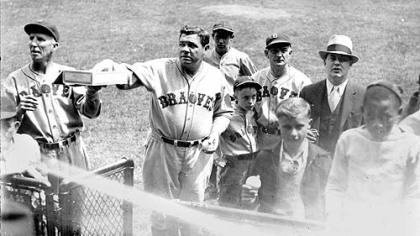
Historic Pittsburgh: Ruth had final hurrah at Forbes ...

Sultan of Swat's three home runs still resonate with so many


Babe Ruth hit the final three home runs of his career at Forbes Field.


By Robert Dvorchak / Pittsburgh Post-Gazette

A.T. Marucci, a student at Brownsville High School, sensed something extraordinary in the air as he caught a ride to Forbes Field for a chance to see a legend three-quarters of a century ago.

The driver, teacher George Zoretic, was saying that dusk was fast descending on the career of Babe Ruth. Not only was the Sultan of Swat struggling at the plate, reports had surfaced that his retirement was imminent because he would never be installed, as promised, as manager of the Boston Braves.

"You may be seeing history," Marucci was told. "It may be his last game."

It wasn't the last game. That would come five days later. But it was the last hurrah of a slugger on his last legs who did something that can only be described as Ruthian.

Summoning up the sublime for the last time, Ruth hit the final three home runs of his career on May 25, 1935, with No. 714 clearing the 86-foot high stands in right field for the first time in a game.

Paul Warhola, brother of artist Andy Warhol, was selling newspapers in the stands that day. He said Ruth called the shot before he launched it.

"There were a bunch of guys where the gamblers sat on the first base side, and you could hear a voice from the stands saying, 'Hey Babe, hit one over the roof!' He heard it and pointed his bat out that way. Sure enough, it cleared everything," said Warhola, now 87. "I'll tell you, that is one of my special memories."

It was a day that time stood still.

Ruth, 40, was hitting about 100 points lower than his weight of 250 pounds and was a shell of his former self.

History notes that Ruth wanted to quit as early as May 12. Braves owner Emil Fuchs lured Ruth back to Boston with a promise of making him manager. But Bill McKechnie, the skipper who had led the Pirates to a championship in 1925, wasn't going anywhere. Ruth, who had parted ways with the Yankees, only agreed to hang on so he could play in every National League park.

He wasn't much of a draw that chilly Saturday, however, as the Braves concluded a three-game set with the Pirates. Only 10,000 were in attendance, including a 15-year-old from Brownsville who paid 35 cents for a bleacher seat.

"It was far from a sellout," said Marucci, now 90 and living in Oakland, Md. "For as many people who claimed they were at that game, it would have been the equivalent of three sellouts at Old Forbes."

But all eyes were on Ruth as he took up his familiar batting stance with one out and a runner aboard in the first inning. Having broken his bat during batting practice, Ruth had fresh lumber for a game played five years before Forbes Field had light standards.

Against Red Lucas, who retired only one batter that day, Ruth lofted a towering fly to right that cleared the screen and landed in the seats.

The ball was retrieved by 20-year-old Emmett Cavanagh of McKeesport, whose family sold the ball for $172,500 at auction at the 2008 All-Star Game.

In the third inning, Ruth had the first of his three plate appearances against Guy Bush. A pitcher with the Chicago Cubs in the 1932 World Series, Bush had plunked Ruth with a pitch. He also was one of the bench jockeys who heckled Ruth before, as the legend goes, he pointed to the stands and hit a called-shot homer in the Series.

Facing Bush again must have energized The Babe. He homered to the second tier of the right-field stands, but no one knows what happened to the ball that became No. 713 on Ruth's home run list.

Then in the fifth, Ruth singled to drive in a run.

Writing for the Pittsburgh Press, baseball writer Volney Walsh contradicted the notion that Ruth had lost his ability to run.

"Just to show there's life in the old legs yet, he raced from first to third on a single with a great thundering sprint, slid into the bag and was ruled safe," Walsh wrote in his account.

And for good measure, he added, "Not only at bat did the Great Man shine, but he turned in three catches in right field, one of which was a beauty."

As Ruth came to bat in the seventh, the fans stirred and urged him to clear the roof that had been built in 1925. As Warhola described it, Ruth acknowledged the cheers and pointed his bat out to right field.

The count was three balls and a strike when Rush offered up a breaking ball. After the sharp crack of the bat, followed by a nanosecond of the crowd rising to its feet, bedlam erupted. Disbelieving fans followed the trajectory as the ball soared out of the park.

"The way he smacked it, you knew it was gone," said Warhola. "The crowd just roared."

From his seat behind his typewriter, Walsh noted that "Pirate players stood in their tracks to watch the flight of the ball."

In his book "Babe: The Legend Comes To Life," Robert W. Creamer quoted Bush as saying: "I never saw a ball hit so hard before or since. He was fat and old, but he still had that great swing. Even when he missed, you could hear the bat go swish."

At Forbes Field, the only way to the visiting clubhouse was through the Pirates dugout. Having finished his day's work, Ruth touched home while doffing his cap and headed to the showers. He paused to relish the moment, plopping down at one end of the bench next to Pirates rookie Mace Brown.

"He said, 'Boy, that last one felt good,' " Brown told Tom Foreman of The Associated Press in 1995.

Estimates put the distance that No. 714 traveled at 550 to 600 feet, but there is no way of knowing. Oakland resident Henry "Wiggy" DeOrio donated the ball he retrieved to the National Baseball Hall of Fame and Museum in Cooperstown, N.Y.

In that one last glorious afternoon, Ruth had belted three of the six home runs he collected that season, and six of the 12 runs he had driven in.


Read More

Father of KDKA Radio: Dr. Frank Conrad


Dr. Frank Conrad, assistant chief engineer of Westinghouse Electric, developed the technology that made KDKA Radio possible. He constructed a transmitter and installed it in a garage near his home in Wilkinsburg in 1916. The station was licensed as 8XK.

When amateur radio operation resumed after the war, most radio messages consisted of amateur radio operators trading information, describing the equipment they were using and where their stations were located. Bored by the chatter, Dr. Conrad chose to introduce entertainment to the airwaves, and on Oct. 17, 1920, he put his microphone by a phonograph.
At 6 p.m. on Nov. 2, 1920, 8KX became KDKA Radio and began broadcasting at 100 watts from a make-shift shack atop one of the Westinghouse manufacturing buildings in East Pittsburgh. The Pittsburgh Post provided election returns by telephone, and returns were relayed to almost a thousand listeners, who learned through this fantastic new medium that Warren G. Harding had defeated James M. Cox in the presidential race. 

Read More

Historic Pittsburgh: KDKA RADIO - First Radio Broadcast in US History!

Beginnings of KDKA, with entire staff of four
 
Pittsburgh's place in radio history is simple: it's the birthplace of commercial radio. KDKA, the market's all-time most successful station, was also the first station ever to broadcast to a mass market. The station was owned by Westinghouse Electric Company, who kicked off a new era in communications, in which people scattered around town could enjoy the same experience without ever leaving their homes.

It started at 8:00 pm, 2 November 1910,with the station broadcasting the  Presidential Election returns, in which Warren Harding defeated James Cox.

By the end of 1923, KDKA was heard regularly all over the United States as well as some parts of Europe, South America and the Hawaiian Islands


Historic Pittsburgh - Photo Gallery

Blooming Mill at Jones & Laughlin
ca. 1885
Frederick T. Gretton Photographs, 1857-1953, MSP 328, Library and Archives Division, Senator John Heinz History Center
1885
Senator John Heinz History Center
Blooming Mill Engine at Jones & Laughlin
August 2, 1886
Frederick T. Gretton Photographs, 1857-1953, MSP 328, Library and Archives Division, Senator John Heinz History Center